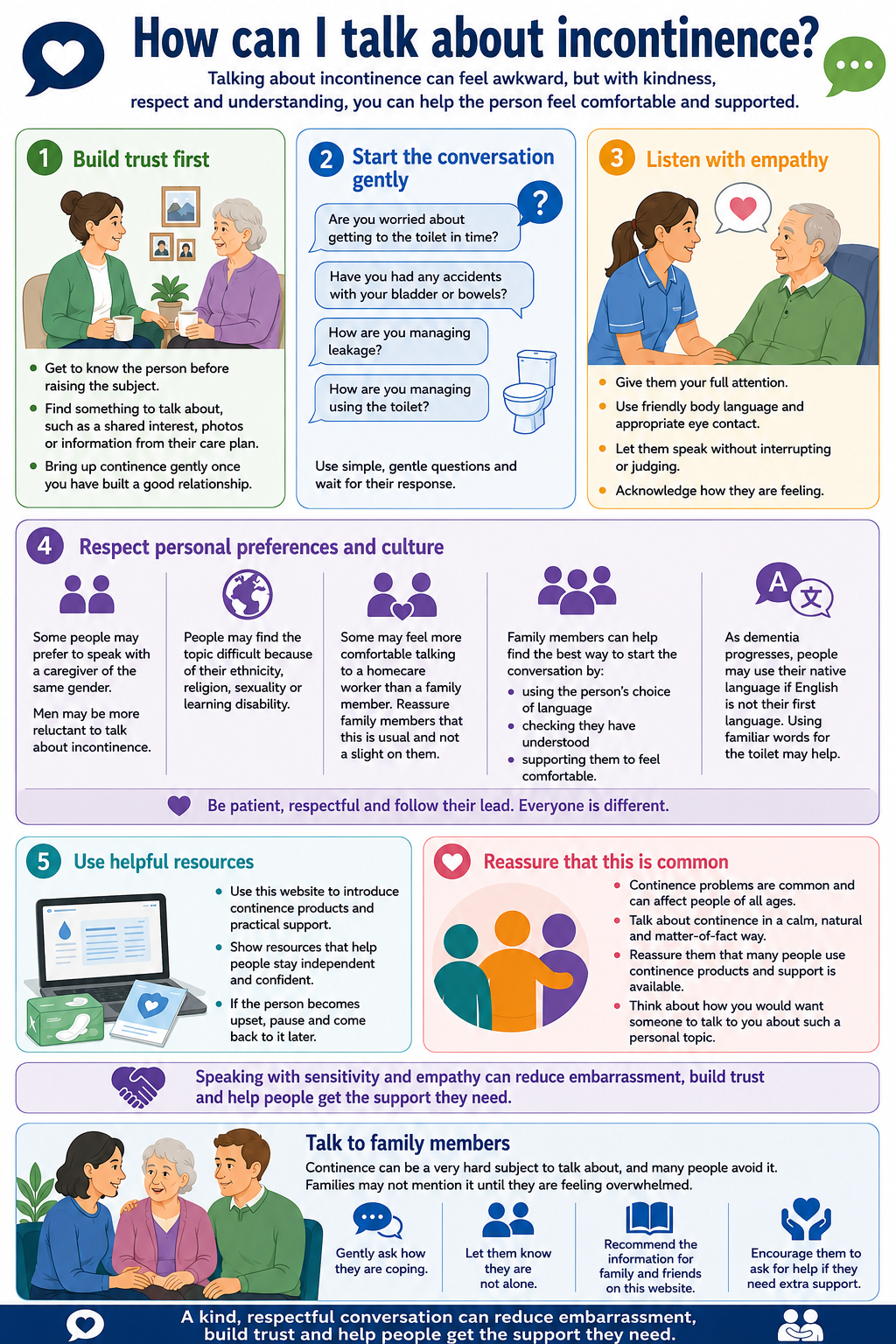
3. How can I talk about incontinence?

Key points


lightbulb

Talking about incontinence can be hard and feel insensitive. An open, respectful and supportive approach can help.

speech bubbles

“When it’s happening you have to support them by saying: ‘No, don’t worry, it’s okay. It does happen to anyone’. That way it will make them feel better. You need to be calm when you talk to them, say it’s okay, always tell them that it’s okay. It’s not you alone. Everybody has got that problem, so don’t feel ashamed of it. That way they will understand, even if it’s hard, they’ll start to understand that they are not the only person suffering from that particular problem”.

Some things that might help are:

  • Build trust first
    • Find a personal connection, for example a shared interest, photographs, information from care plan
    • Raise the topic gently, having built rapport
  • Starting the conversation
    • If you think there is a continence concern you might start a conversation by gently asking:
      ’Are you worried about having an accident because of not getting to the toilet in time?’ OR
      ‘Are you having any accidents with pee or poo?’
  • Listen and show understanding
    • Give your full attention
    • Use positive body language and maintain direct eye contact
    • Encourage honesty without judgement.
speech bubbles

“The language you use is important. You don’t use baby talk. There is a stigma attached to being incontinent. I’ve got one lady that laughs and calls them her pee pants. And I’ve got another lady who calls it her underwear. She doesn’t like it to be called inco-wear or anything else, it’s her underwear. So, it’s like, follow my lead. You’re not in there to take control, you’re in there to help them, aid them if they need it”.

  • Respect preferences and culture
    • Some people may prefer to talk about this with someone of the same gender
    • Men may be more reluctant to talk about incontinence
    • People may be reluctant to talk about the subject because of, for examples, their ethnicity/religion/learning difficulty/sexuality
    • People may feel more comfortable talking about incontinence with a homecare worker rather than a family member. If so, you may need to reassure family members that this is usual and not a slight on them
    • Family members can help decide the best way to start the conversation
    • Use their choice of language and check they have understood
    • As dementia progresses, people may use their native language if English is not their first language. It may be helpful to use the terms in their mother tongue for going to the toilet (use Google Translate, or wait for someone else to be present to translate).
  • Use this website as an icebreaker
    • Use it to introduce continence products
    • Show resources that support independence and build confidence
    • If your client is upset, pause and come back to it later.
speech bubbles

“When you’re talking about continence and actually going towards that, saying: ‘Look, we’re looking at continence, can I share this website with you? Can you share your views’? Because, in talking to the client as if the client is the expert and you’re using the website to guide them, for the client to guide you on how you would like them to deal with any concerns they have”.

“ A touch of humour may help: ‘Why don’t we try these and see if we look as glamorous as the lady in the advert!’ ”

Practical Tips

  • Raise the topic gently, having built rapport
  • Ask a question with empathy, such as: ‘Are you worried about having accidents with pee or poo?’
  • Use language your client is comfortable with
  • Be led by your client and find out their concerns

Reassure and normalise

  • Having issues with continence is very usual for many people, not only the elderly or people who have dementia
  • You can help your clients feel comfortable and confident with their situation by speaking naturally and factually with them
  • Emphasising that having continence concerns is a common problem can help your clients to open up and not be embarrassed to talk about incontinence
  • Reassure your client that a lot of people use continence products and that supermarkets have shelves stacked with incontinence wear
  • Think about how you would want someone to talk to you about your own toileting needs, and how it might feel, if you were living with incontinence
  • Speaking about continence with sensitivity and empathy can help them manage their continence well. You might start a conversation by asking: ’How are you managing leakage?’ or, ‘How are you managing using the toilet’?
speech bubbles

“Whether you’re dealing with the elderly or dementia, it doesn’t matter. If they’re towards the latter stages of dementia, there’s still a person inside there and you’ve got to be as sensitive as if you’re coming to talk to me. They have led a whole, active life. They’re married or whatever, they’ve had children, they’ve had jobs. They’re not babies. They’re not children. You just talk how you would like to be spoken to”.

Talk to family members

Continence can be a very hard subject to talk about, and many people avoid it. Incontinence is often one of the hardest things for families to manage, and they may not mention it until they are feeling overwhelmed. They will often be very grateful if you gently ask how they are coping, especially if they have been avoiding the subject. You might also suggest that they look at the information for family and friends on this website.