6. How can I support my client to be independent whilst helping with their continence?
Key points

Toilet routine
Doing the same thing each time can make it easier for your client to remember. People with dementia often like routine, and they may become upset if things change. Having prompts around the house and in the bathroom can help to remind them of what to do. Rushing can confuse and distress them, so planning ahead is helpful.
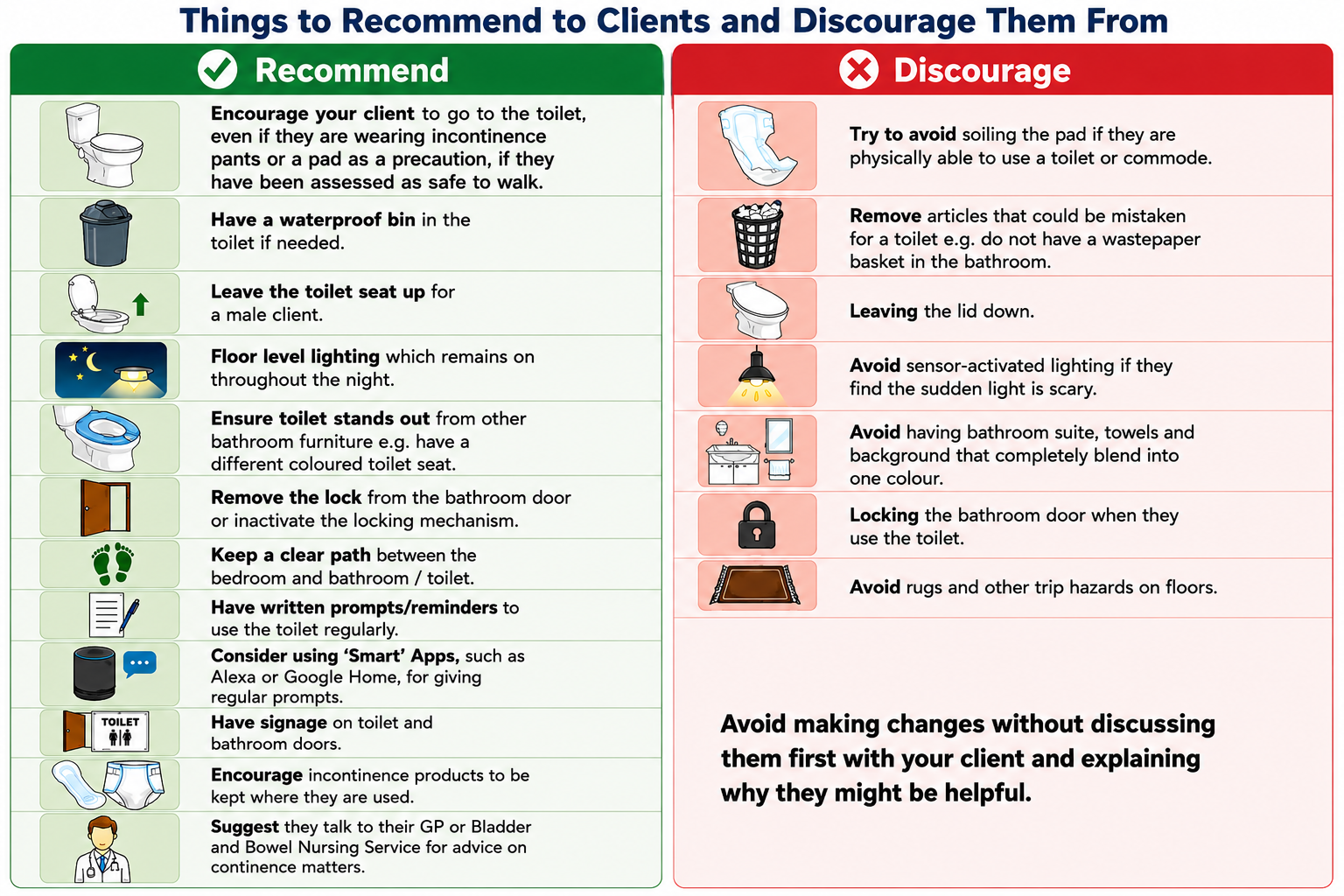
Get to know about your client’s life and history, so they feel comfortable with you and trust you to help them with their personal care. Learn what routines they prefer and help them keep these. Keep incontinence pads or pants in the bathroom so they are easy to reach. You may need to guide them on which products are best to use (see section 7).
Keeping safe
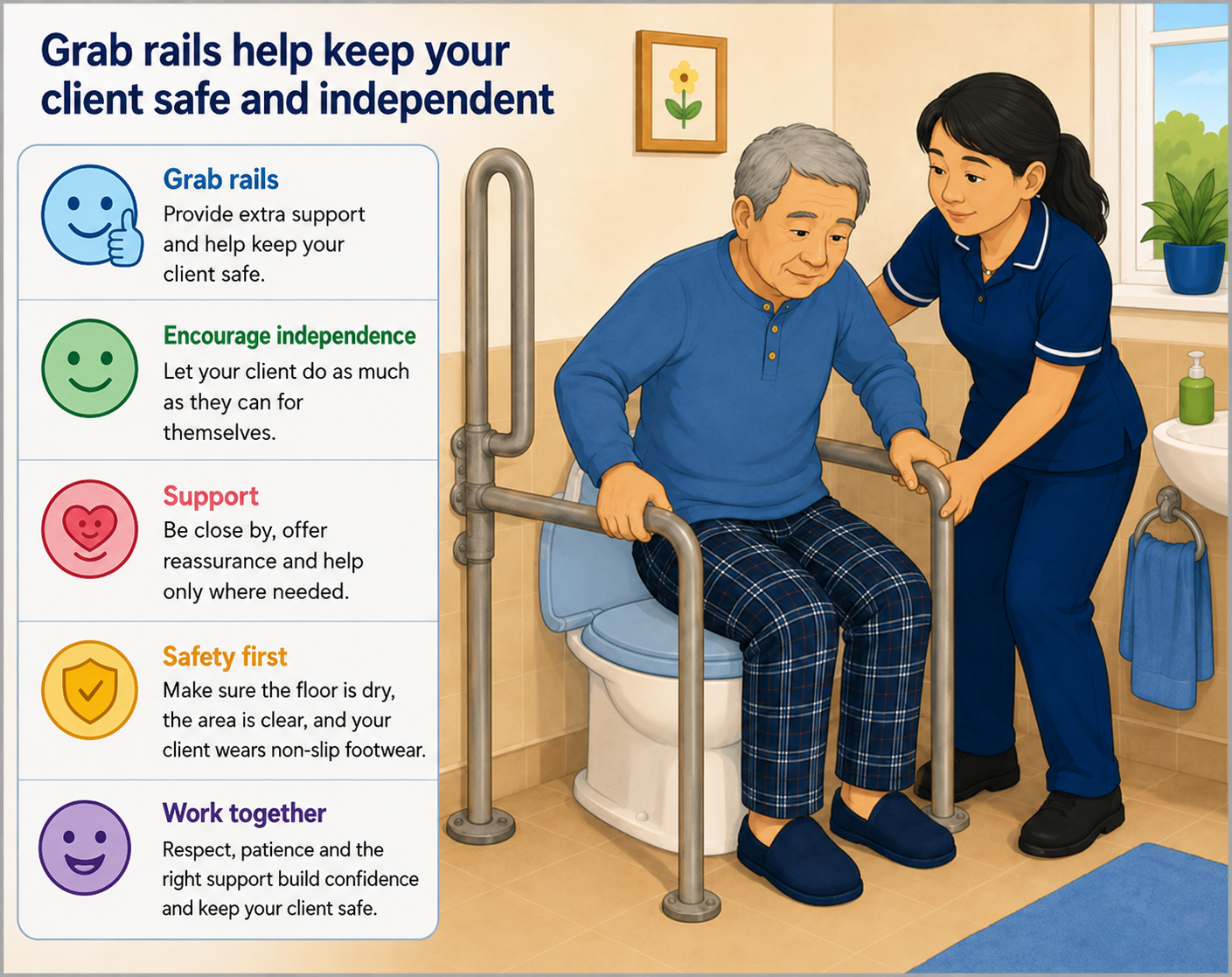
Occupational Therapists can provide equipment like raised toilet seats and grab rails. Physiotherapists can help with walking aids like frames. If you think your client would benefit, ask your manager to arrange an assessment. To make grab rails easier to see, you can wrap coloured tape around them — using the person’s favourite colour may encourage them to use it
The therapists will show your clients how to use their equipment correctly, but you may need to remind them if they forget and reassure them that it is there to help them.
If necessary, ask the physiotherapist or occupational therapist for a review.
Encourage your client to keep their living space tidy. Keep floors clear of trip hazards, like rugs and lamp cords. Be aware of differences in floor levels between rooms, as a small step can create a significant trip hazard. Having a dim light on at low level and a clear path from the bedroom to the bathroom can help prevent falls at night. You could also use motion-sensor lights that turn on when someone walks past. However, some people may find sudden lights frightening, so check what your client would prefer when suggesting night-time lighting.
Avoid having a wet floor. . Men may have trouble aiming when they stand to urinate. Some carers use toilet stickers or a coloured ping-pong ball in the toilet bowl as a target, or encourage men to sit down when urinating. Be mindful if you suggest these ideas that it could upset your client. Having a trusting relationship can make these conversations easier.

“If a client is becoming distressed about the fact that they know that there’s a puddle on the floor every time they leave the bathroom, turn it around and go: ‘Okay, and what can we do about this? Why don’t we try this? If you don’t like it, we take it away’ ”.
“It’s a case of trying things and see how they work. And saying to the person: ‘I was thinking about putting a ping pong ball in the toilet so that you can aim for the ping pong ball. Is that going to help you? How are you going to feel about that?’ And if they go, ‘No’, that’s fine. And, if it’s on a website saying this might be helpful, instead of you suggesting it, you direct them to the website and say: ‘Look, I’ve seen this on my phone. Do you want to try it?’ So it’s the website that is to blame, not the carer”.
Bathrooms can be small and difficult to get into if someone falls or locks the door. You might suggest to your client that they think about changing the door so it opens outwards, or replace it with a curtain to make access easier in an emergency.
Supporting activity and toilet use
Staying active helps older people stay strong and independent. Walking to the toilet can also be gentle exercise. Find out what encourages them to walk - some may enjoy singing or dancing on the way. If they are unsteady, don’t leave them alone. Give privacy, while staying nearby for safety:
- Stand to the side or slightly behind.
- Look away to give them dignity.
- Stay close enough to reassure them.
- Make sure toilet paper is easy to reach when they are seated.
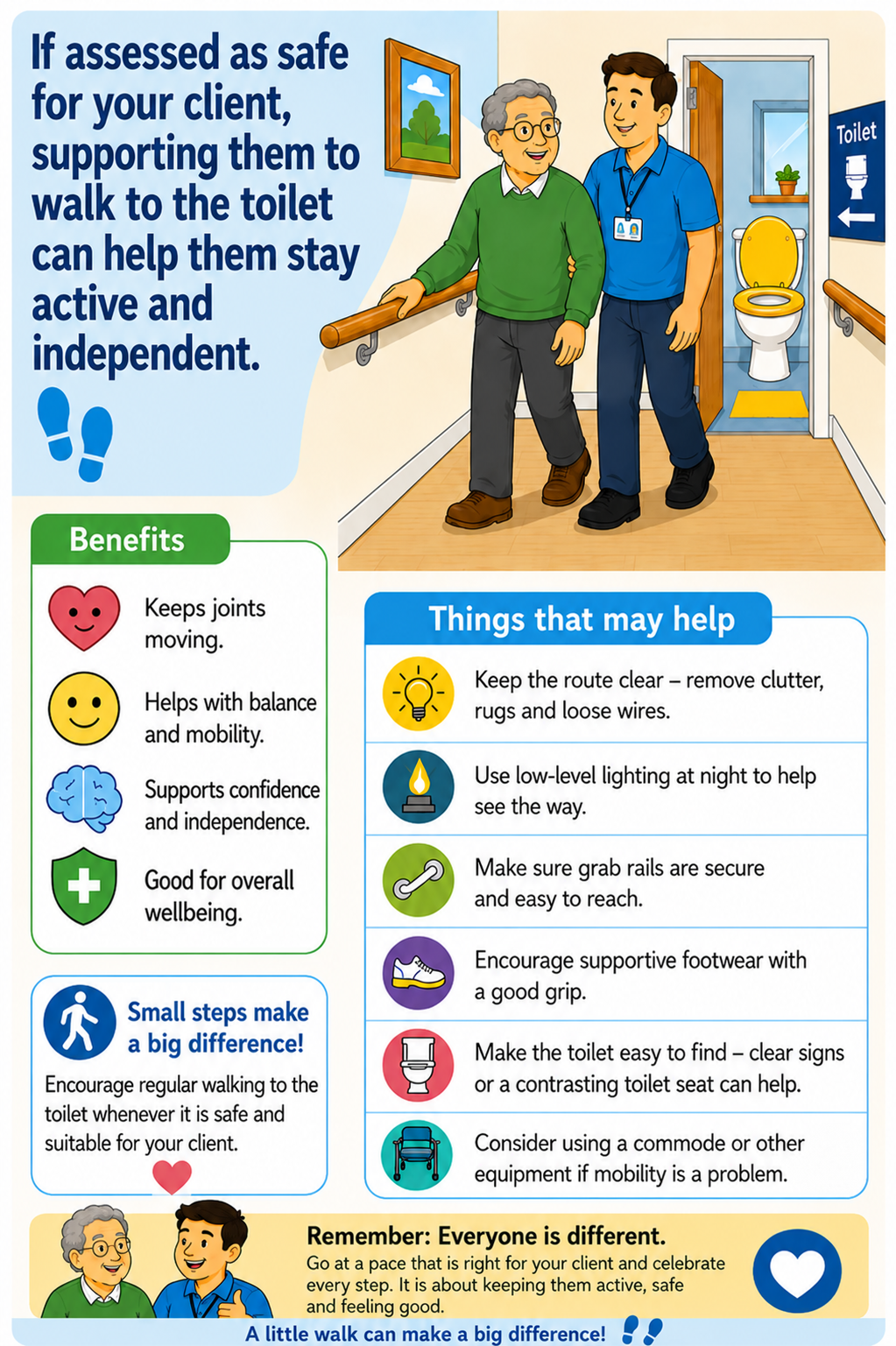
Help your client to exercise by walking to the toilet, if it is safe for them.
Consider making bathroom furniture such as the toilet seat and grab rails stand out, using a contrasting colour or tape.
“Using the toilet can be fun if we’re going to go marching to the toilet going: ‘Hey ho, hey ho’. You know, have a little toilet song that we use as we go towards it. It doesn’t have to be a horrible thing.”
“I used to look after a lady, she used to like singing the Grand Old Duke of York going towards the bathroom. She used to love it. So, as soon as we started singing that, she knew she was going in for a shower and go to the toilet”.
Practical Tips
- Try putting a ping-pong ball in the toilet bowl as something for men to aim at to help avoid a wet floor.
- Make walks to the toilet enjoyable, such as by encouraging your client to sing a familiar song.
- Low-level lighting can help avoid falls at night.
- Not all ideas work for everyone, and something that doesn’t work today might work another day.
- You may need to remind or guide your client each time they go to the toilet.
Promoting choice and independence
Help your clients to keep control over their life for as long as possible:
- Let your client make choices whenever possible.
- Use gentle suggestions instead of instructions.
- Encourage positive actions and guide them away from unsafe ones.
“With the dementia it may be something that you have to approach every time. And it may be sometimes the person says: ‘No, I don’t want that’. But other times they may go: ‘Oh yeah, that would be brilliant!’ ”.